Check My Latest Blog Posts
Best and Worst Flooring Choices for Your Home in 2026
Updated August 2026
Flooring is one of those home improvements that seems simple until you actually start shopping.
Hardwood or engineered hardwood?
Luxury vinyl plank or laminate?
Tile or carpet?
And then you walk into a flooring store and discover hundreds of colors, materials, thicknesses, wear layers, and price points.
I've flipped and renovated many homes through the years, updated my own rental properties, and walked through hundreds of homes with buyers. Flooring is one of the first things I notice when evaluating a property, and buyers notice it too.
The wrong flooring doesn't automatically destroy a home's value, but poor material selection, bad installation, excessive wear, or flooring that doesn't fit the property can absolutely affect how buyers perceive a home.
If you're remodeling, preparing to sell, flipping a house, or updating a rental property in 2026, here's how I look at the major flooring choices.
Why Flooring Matters When Selling a Home
Buyers see the floors almost immediately.
They also see a potential expense.
Old stained carpet doesn't just look bad. Buyers start calculating replacement costs.
Damaged hardwood becomes a refinishing project.
Cheap flooring that moves under their feet makes them question the quality of the renovation.
A poorly installed floor can even make buyers wonder what other corners were cut.
That's why I don't believe the goal should always be finding the cheapest flooring.
The goal is finding the right flooring for the property, budget, expected use, and timeframe.
Solid Hardwood Flooring
There's a reason hardwood has remained desirable for generations.
It can provide warmth and character that manufactured flooring sometimes struggles to replicate.
Common hardwood choices include oak, maple, cherry, walnut, and other species.
One of hardwood's biggest advantages is longevity.
Quality hardwood can potentially be refinished multiple times rather than completely replaced.
That's especially valuable in older homes where original hardwood can be part of the property's character.
Where Hardwood Makes Sense
I particularly like hardwood in:
Living rooms.
Dining rooms.
Bedrooms.
Hallways.
Main living areas.
I'm more cautious using traditional hardwood in bathrooms, laundry rooms, and other areas that regularly encounter moisture.
Kitchens are possible, but homeowners need to understand the potential for water damage.
Is Hardwood Worth Installing Before Selling?
This is where I would be careful.
If you're staying in the home for years and you love hardwood, it may make perfect sense.
If you're flipping a moderately priced property or planning to sell soon, installing expensive hardwood throughout the entire house may be more money than you need to spend.
However, if your home already has original hardwood underneath old carpet, that's a completely different conversation.
In many cases, I'd investigate whether those floors can be refinished before covering them with something else.
Engineered Hardwood
Engineered hardwood can give homeowners much of the appearance of traditional hardwood while using a layered construction.
The top layer is real wood veneer, while the layers underneath provide stability.
It can be an excellent middle ground.
You get real wood on the surface without necessarily paying what you'd spend for premium solid hardwood.
One Important Difference
Solid hardwood can generally be refinished multiple times.
Engineered hardwood varies.
Some higher-quality engineered products can be refinished depending on the thickness of the wear layer, while thinner products may have limited or no refinishing potential.
That's something I'd verify before buying.
For homeowners who want real wood but need something potentially more dimensionally stable than traditional hardwood, engineered hardwood deserves consideration.
Luxury Vinyl Plank
Luxury vinyl plank, or LVP, has become one of the most common flooring products I see in renovations.
I've used it myself.
And there's a reason.
Good LVP can be:
Water resistant or waterproof depending on the product.
Durable.
Relatively affordable.
Easy to clean.
Available in realistic wood appearances.
Suitable for many areas of the house.
It's also a practical option for rental properties and certain flips where durability is important.
The Big LVP Mistake
Not all LVP looks the same.
Some inexpensive products can immediately give a renovation a budget appearance.
That doesn't mean inexpensive is automatically bad.
It means don't choose flooring based entirely on price per square foot.
Look at the texture.
Look at the pattern repetition.
Look at plank width.
Look at the wear layer.
Look at how the color works with the rest of the house.
And in 2026, I would also be careful with extremely cool gray LVP.
Warmer and more natural wood appearances can give a home a less trend-specific look.
Traditional Vinyl Flooring
Traditional vinyl can still make sense where budget is the primary concern.
It's affordable, easy to maintain, and can work well in moisture-prone areas depending on the product.
For rental properties, laundry rooms, utility areas, and certain entry-level renovations, it can be perfectly practical.
Where I'd be cautious is using obviously inexpensive peel-and-stick products throughout a house that otherwise presents as a higher-quality renovation.
Buyers notice inconsistencies.
If the countertops, cabinets, appliances, and bathrooms look expensive but the flooring looks like the least expensive product available, it can pull the entire renovation down.
Tile Flooring
Tile remains one of my favorite choices for bathrooms and other moisture-prone areas.
Porcelain and ceramic products are available at almost every price point and in an enormous range of styles.
Tile can be:
Durable.
Water resistant.
Easy to clean.
Long lasting.
Available in countless designs.
But there's a downside people sometimes forget.
Tile Is Expensive to Change
Installing tile throughout an entire home may work in certain climates and architectural styles.
In Colorado, I would think carefully before doing that.
If the next buyer doesn't like it, removing hundreds or thousands of square feet of tile is a major project.
For many of my projects, I prefer keeping tile in appropriate areas such as bathrooms while using another flooring material through the primary living spaces.
Laminate Flooring
Laminate has improved considerably over the years.
It can provide a convincing wood appearance at a relatively affordable price and can be DIY-friendly.
But installation is critical.
I've walked into homes where a relatively new laminate floor moves and flexes under your feet.
That's not necessarily the flooring's fault.
It can result from:
An uneven subfloor.
Poor preparation.
Incorrect expansion gaps.
Improper underlayment.
Bad installation.
When buyers feel the floor moving underneath them, the entire installation can feel cheap regardless of what the material actually cost.
Laminate vs. LVP
One reason LVP has become so popular is moisture resistance.
Traditional laminate products have historically been more vulnerable to water, although newer water-resistant and waterproof laminate options have expanded considerably.
If you're comparing the two in 2026, don't make the decision based solely on the words "laminate" or "vinyl."
Compare the actual products.
Carpet
Carpet isn't dead.
Despite what you may hear, plenty of homeowners still like carpet, especially in bedrooms.
It provides warmth, softness, and sound absorption.
It can also be relatively inexpensive compared with some hard-surface flooring.
For resale, I often like a combination.
A durable hard surface through the main living areas with carpet in bedrooms can work very well.
Where I Would Avoid Carpet
Bathrooms.
I can't think of many situations where I would intentionally install new carpet in a bathroom for resale.
Moisture and carpet simply aren't a good combination.
I'd also be cautious about extremely cheap carpet with an extremely thin pad.
Buyers can feel the difference immediately.
You don't necessarily need luxury carpet for a resale project. A decent middle-of-the-road carpet and pad can make a house feel fresh without overspending.
What Flooring Is Best for Rental Properties?
Rental flooring is a different decision from flooring in your personal residence.
For rentals, I'm thinking about:
Durability.
Turnover costs.
Pets.
Water resistance.
Ease of cleaning.
Repairability.
Replacement cost.
That's why a good-quality LVP can make a lot of sense.
Carpet may cost less initially, but repeated cleaning and replacement between tenants can add up.
Tile can be extremely durable but expensive to repair or change.
Hardwood can last decades, but tenants, pets, furniture, and water can create maintenance concerns.
The best rental flooring isn't necessarily the prettiest flooring.
It's the flooring that balances appearance with long-term operating costs.
What Flooring Is Best for a Fix and Flip?
This depends heavily on the price point.
I wouldn't install the same flooring in a luxury property that I'd install in an entry-level flip.
That's one of the biggest renovation mistakes investors make.
They either overspend for the neighborhood or go so cheap that the house feels like a flip the second a buyer walks through the door.
For many moderately priced properties, I like a quality hard-surface flooring in the primary living spaces with appropriate tile in bathrooms and potentially carpet in bedrooms.
Higher-end homes may justify hardwood or higher-quality engineered products.
The flooring should match buyer expectations for that neighborhood.
Flooring Mistakes I Would Avoid
There are several flooring decisions I've seen cause unnecessary problems.
Going too cheap. Buyers may not know the product's brand, but they can often recognize poor quality or installation.
Using too many different floors. Five different flooring materials can make a house feel chopped up.
Ignoring the subfloor. Expensive flooring installed over a bad surface can still look and feel terrible.
Choosing flooring purely because it's trendy. Today's hottest color can become tomorrow's dated renovation.
Using moisture-sensitive products in the wrong places. Bathrooms, laundry rooms, basements, and kitchens need extra consideration.
Installing flooring without considering resale. A highly personal flooring choice may narrow your future buyer pool.
My Advice From Renovating Homes
If I'm selecting flooring, I start with the property instead of the flooring store.
What is the home worth?
Who is likely to buy or rent it?
How long will the owner keep it?
Does the house have pets or children?
Is moisture a concern?
What flooring is typical for comparable homes?
How much money makes sense to invest?
Only then would I choose the material.
A $4 flooring product can be a smarter choice than a $12 product in one property.
In another home, spending more could absolutely be justified.
Context matters.
Quick Flooring Guide
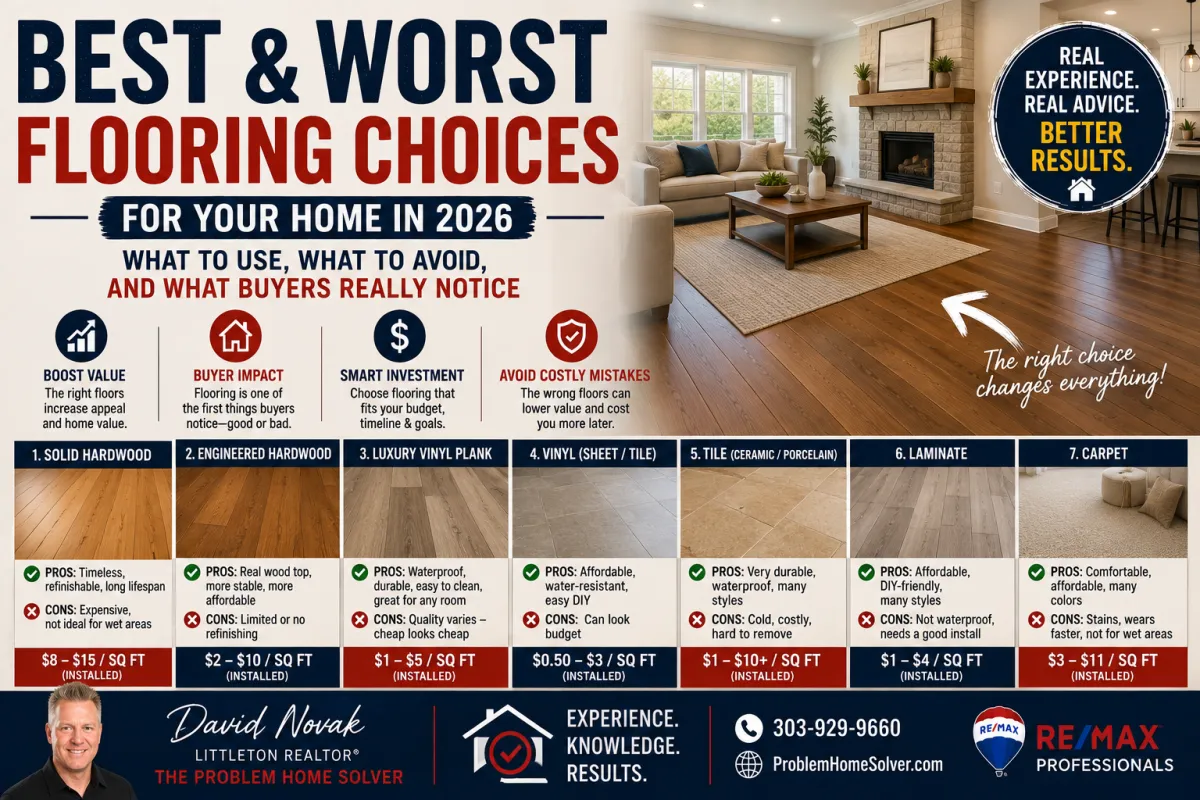
FlooringWhere I Like ItMain ConcernSolid hardwoodHigher-end and long-term homesCost and moistureEngineered hardwoodHomeowners wanting real wood appearanceProduct quality variesLVPFlips, rentals and everyday homesCheap products can look cheapVinylBudget-conscious applicationsResale presentationTileBathrooms and moisture-prone areasCost and difficulty of removalLaminateBudget renovationsSubfloor and installation qualityCarpetBedrooms and comfortable living spacesWear, stains and shorter lifespan
What Should You Install Before Selling Your Littleton Home?
If you're getting ready to sell, don't automatically replace every floor.
Sometimes refinishing existing hardwood makes more sense.
Sometimes replacing worn carpet is enough.
Sometimes continuous LVP dramatically improves the presentation.
And sometimes the flooring is perfectly fine and your money is better spent somewhere else.
That's why I recommend looking at the entire property before spending thousands of dollars.
I'm David Novak, a Littleton Realtor with RE/MAX Professionals, known as the Problem Home Solver. I've worked with buyers, sellers, investors, rentals, and renovation properties throughout the Denver metro area.
If you're considering selling and aren't sure whether your flooring should be replaced, refinished, cleaned, or simply left alone, I'm happy to take a look before you spend the money.
Call or text: 303-929-9660
Visit: ProblemHomeSolver.com

Are you tired of feeling like you can't trust real estate agents?
You’re not alone—and that’s exactly why I do things differently. With 30+ years in real estate, from running a mortgage bank to flipping homes and helping hundreds of families buy and sell, I’ve seen the good, the bad, and the downright ugly. My job isn’t to “sell” you—it’s to guide you with straight answers, real numbers, and options that actually make sense for your situation.
And if you’re not in my area, no problem—I can connect you with a top, experienced agent you can trust in your market.
👉 Fill out the form on my contact page or reach out directly, and let’s talk about how I can help you make the right move without the games.
Facebook
Instagram
X
LinkedIn
Youtube
Website