
Check My Latest Blog Posts
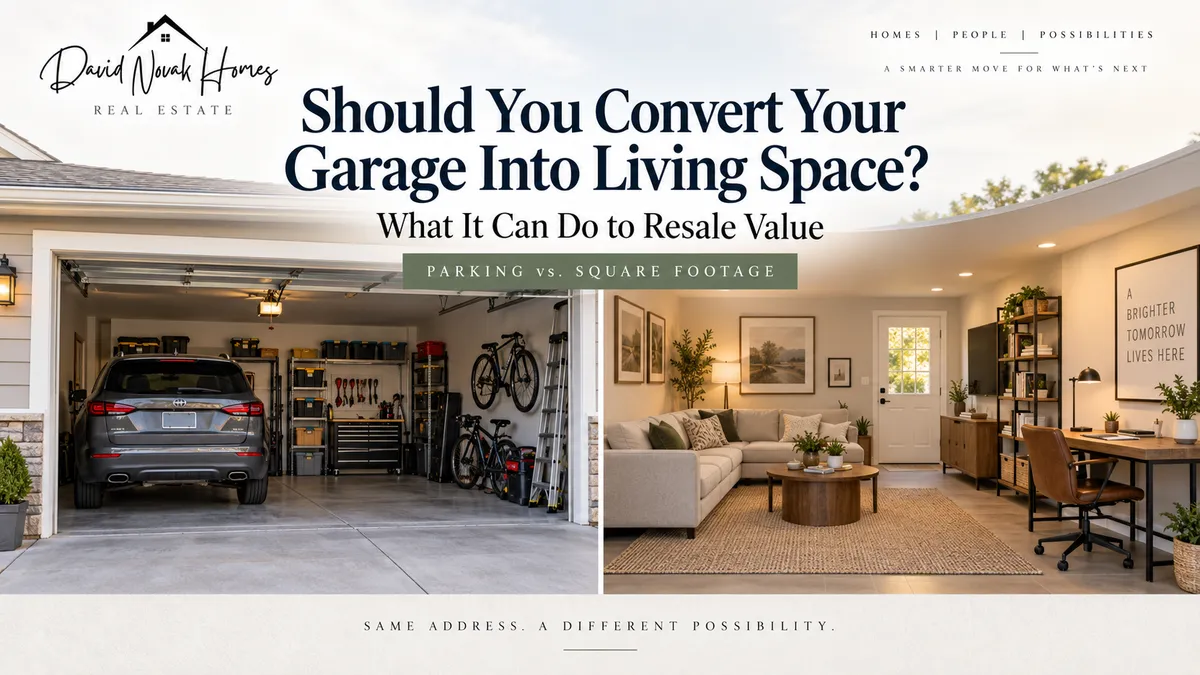
Should You Convert Your Garage Into Living Space? What It Can Do to Resale Value
That two-car garage can look like a lot of wasted square footage.
Especially if you aren't parking cars in it.
You start looking around and thinking:
What if I turned this into another bedroom?
Or a family room?
Home office?
Gym?
Maybe even an apartment?
I've had this same thought on properties I've renovated.
Sometimes converting a garage into living space makes complete sense.
But if you're thinking about selling your home in the next few years, I would be very careful before eliminating a garage just to gain finished square footage.
You may be adding something buyers like while simultaneously removing something they value even more.
I discuss garage conversions along with several other improvements that homeowners sometimes regret in my main guide:
10 Home Features Homeowners Often Regret After Remodeling
The real question isn't simply whether you can convert the garage.
It's whether you should.
Does Converting a Garage Add Value to Your Home?
It can.
But additional finished square footage doesn't automatically mean an equal increase in value.
That's where homeowners can get into trouble.
Let's say you have a 1,800-square-foot home with a two-car garage.
You convert the garage and gain another 400 or 500 square feet of usable interior space.
On paper, that sounds fantastic.
But now you have a larger house with no garage.
If almost every competing home in your neighborhood has a two-car garage, buyers aren't necessarily going to look at your house and simply say:
Great. More square footage.
Some are going to say:
Where am I putting my cars?
And in Colorado, that's not a minor question.
Garages Matter More in Colorado
I work primarily in Littleton and southwest Denver, and garages have real functional value here.
We get snow.
Hail.
Cold temperatures.
Hot summer sun.
And plenty of homeowners have far more than two cars' worth of belongings stored in their two-car garage.
Garages hold:
Cars
Bikes
Mountain bikes
Tools
Lawn equipment
Snowblowers
Golf clubs
Camping equipment
Holiday decorations
Kids' equipment
Storage bins
Workbenches
Then there is the obvious benefit of not scraping ice off your windshield at 6:30 in the morning.
That's why I'd be hesitant to eliminate a garage in a neighborhood where buyers expect one.
Your main house may technically become larger.
But the property can become less functional at the same time.
That's one of the recurring themes in my broader article about home features homeowners often regret: a renovation shouldn't sacrifice an important function simply to create something that looks good on paper.
Look at the Neighborhood Before You Touch the Garage
This would be one of my first steps.
Pull up comparable homes.
What does your competition look like?
If practically every house in the neighborhood has:
Three bedrooms.
Two bathrooms.
A basement.
And a two-car garage.
Turning yours into a four-bedroom home with no garage could actually make the house harder to compare.
You've gained a bedroom.
But you've removed one of the neighborhood's expected features.
That's not automatically a winning trade.
On the other hand, perhaps you're in an older neighborhood where garages are uncommon or many homes already have converted garages.
Different story.
Real estate is extremely location-specific.
What works in one Littleton neighborhood may make absolutely no sense five miles away.
Garage Conversion vs. Adding a Bedroom
This is where homeowners often get excited.
Bedrooms can absolutely add utility.
Maybe you have a three-bedroom home and really need a fourth bedroom.
A garage seems like the easiest place to create it.
But I would ask:
Can we create that bedroom somewhere else?
Is there unfinished basement space?
Could another room be reconfigured?
Could an egress window turn an existing basement room into a legitimate bedroom?
Could the garage remain partially functional?
Before permanently eliminating a valuable feature, I like to see whether there's another way to accomplish the same goal.
Is a Converted Garage Actually Finished Square Footage?
Don't assume it is.
Just putting carpet down and installing drywall doesn't necessarily turn a garage into legitimate living space.
There can be requirements involving:
Permits.
Insulation.
Heating.
Electrical.
Ceiling height.
Egress.
Fire separation.
Windows.
Ventilation.
Foundation or floor level.
Parking requirements.
Zoning.
Building codes.
And potentially HOA restrictions.
Your city or county determines what is required.
This becomes especially important when you eventually sell.
A buyer may ask whether the work was permitted.
An appraiser may look at how the space was converted.
An inspector may identify issues.
The title "finished garage" doesn't automatically mean an appraiser or local jurisdiction will treat the area the same way as the original finished portion of the house.
The Garage Floor Can Create Problems
Garages weren't originally designed like bedrooms.
The concrete slab may be lower than the rest of the house.
It may slope.
There may be moisture considerations.
The floor can be cold.
Depending on the conversion, properly insulating and leveling the floor can become much more involved than homeowners originally expect.
I've seen plenty of renovation projects where the idea sounded inexpensive until the details started adding up.
That's why I don't like estimating a garage conversion based on:
It's already framed. We just need some drywall and flooring.
Usually, there's more to it than that.
Heating and Cooling Matter
Colorado garages aren't typically conditioned to the same standard as the interior of a house.
If you're turning the garage into a bedroom, family room, or office, that changes.
Now somebody is expected to comfortably live in the space in January and July.
That may require changes to:
HVAC.
Insulation.
Exterior walls.
Garage doors.
Windows.
Air sealing.
Electrical.
The old garage door opening also has to be addressed appropriately.
Simply building a wall behind an existing garage door may be inexpensive, but it can make the conversion look temporary.
And buyers notice temporary-looking work.
A Bad Garage Conversion Can Hurt the Whole House
This is the part I think homeowners underestimate.
An obvious DIY garage conversion doesn't just affect that room.
It can change the buyer's impression of the entire property.
They see:
Uneven flooring.
An old garage door still visible outside.
Questionable heating.
Poor trim work.
Odd ceiling transitions.
Cheap windows.
Extension cords running around.
And they start thinking:
Was this permitted?
Then:
What else did they do themselves?
I've worked with enough buyers to know that one questionable renovation can cause them to become suspicious about everything else.
Good workmanship matters.
Should You Convert a Garage Into a Home Office?
This got much more popular as working from home became common.
But I would still hesitate to permanently eliminate a good garage solely for an office.
There may be better options.
Finish part of the basement.
Convert an underused bedroom.
Create an office nook.
Finish space above the garage if the house allows it.
Or create a garage that can serve multiple functions.
If your garage is insulated, heated, finished, and organized, you may be able to use part of it as workspace without permanently removing its ability to function as a garage.
Flexibility usually helps resale.
What About Turning the Garage Into a Bedroom?
This can make more sense in certain situations.
Maybe you have an older home where the bedroom count is unusually low compared with nearby properties.
Maybe there isn't another realistic location for an additional bedroom.
Maybe the garage has already been partially converted.
Maybe the property has another detached garage.
Those factors change the equation considerably.
If I'm looking at a property with:
A two-car attached garage plus a detached two-car garage?
Converting some attached garage space may be much easier to justify.
But if we're taking the home's only two-car garage and eliminating it completely?
I'd want a very good reason.
Garage Conversion Into an ADU
This is another interesting possibility.
Accessory dwelling units can create completely different economics.
Instead of merely adding a family room, perhaps the garage becomes a legal separate living space that can potentially serve:
Parents.
Adult children.
Caregivers.
Guests.
Or rental use where legally permitted.
Now we're looking at more than just an extra room.
But the keyword there is legal.
Before spending money, you need to understand local zoning, building requirements, utilities, parking, entrances, fire separation, and other regulations that may apply.
Don't build first and ask questions later.
Converting a Detached Garage
I look at detached garages a little differently.
Suppose your property has:
A two-car attached garage.
And an old detached garage or oversized workshop in the backyard.
Converting that detached structure may create usable space without eliminating the home's primary parking.
That can make the idea considerably more appealing.
You still need to deal with permits, utilities, zoning, insulation, heating, and all the other issues.
But from a resale standpoint, you haven't necessarily sacrificed the garage buyers expect.
What If You Never Park in the Garage Anyway?
This is something homeowners tell me all the time.
We don't even use the garage for cars.
That's fine.
But remember:
You're not the only future buyer.
You may use it as a workshop.
The next buyer may have a classic car.
You may store furniture there.
The next buyer may have two teenagers driving.
You may turn it into a gym.
The next owner may want room for bicycles and skis.
If you're planning to stay in the house for another 20 years, your needs deserve most of the weight.
But if you're planning to sell next year?
Now I'd think about the next buyer too.
What About Leaving the Garage Door?
I've seen conversions where the exterior still looks exactly like a garage.
The garage door remains.
Inside, somebody builds a wall behind it.
Technically, the room may function as interior space.
But visually, it can feel like a compromise.
The buyer walks in and knows:
I'm standing in a garage somebody turned into a bedroom.
That's different from a professionally designed conversion where the exterior architecture was addressed correctly.
Again, this isn't simply about adding drywall.
Details matter.
Can You Convert Only Part of the Garage?
Sometimes this is the best compromise.
For example, maybe an oversized two-car or three-car garage allows you to create:
A mudroom.
Laundry room.
Small office.
Workshop.
Storage room.
Or mechanical area.
While retaining usable parking.
That can potentially improve functionality rather than simply trading one feature for another.
I usually like renovations that give buyers more flexibility, not less.
What About Converting a Three-Car Garage to Two?
This is another situation where I might be much more open to the idea.
Let's say you have a three-car garage in a neighborhood where two-car garages are common.
Converting the third bay into a home office or mudroom while retaining a full two-car garage may make sense.
You're still giving future buyers protected parking and storage.
That's very different from eliminating the only garage.
Context matters.
Should You Convert a Garage Before Selling?
In most cases, I wouldn't convert a functional garage simply because you're preparing to sell.
That's a lot of money and risk to take immediately before listing.
I'd rather improve things buyers are much more likely to reward:
Deferred maintenance.
Paint.
Flooring.
Lighting.
Kitchen presentation.
Bathroom condition.
Curb appeal.
Landscaping.
Roof issues.
Mechanical systems.
A garage conversion is a major structural and functional change.
That's very different from updating worn carpet.
What If the Garage Is Already Converted?
Now we're solving a different problem.
If you bought the house with a converted garage, I'd figure out what we actually have.
Was it permitted?
Does it meet code?
Is the conversion legally recognized?
How does it compare with neighborhood homes?
Could it easily be converted back?
Does it look professional?
Does the property still have adequate parking?
I wouldn't automatically tear it apart.
There are buyers who may love the extra space.
But I want to understand exactly what we're marketing before the house goes on the market.
Converting It Back to a Garage Before Selling
Sometimes this makes sense.
Suppose the garage was poorly converted decades ago.
The room doesn't have proper heat.
It feels like a garage.
Parking is limited.
And every comparable home has a two-car garage.
Restoring the garage may actually improve marketability.
But again, I wouldn't make that decision without looking at the economics.
If restoration costs $30,000 and is unlikely to change the sale price enough to justify it, maybe we market the house differently.
I don't believe in spending money simply because something isn't ideal.
There needs to be a reason.
Buyers Value Flexibility
This is one of the biggest lessons I've learned after years of buying, renovating, and selling homes.
Buyers like options.
A bedroom can be:
A bedroom.
Office.
Guest room.
Workout room.
Hobby space.
A garage can be:
Parking.
Storage.
Workshop.
Gym.
Bike storage.
Project space.
Removing a flexible space and turning it into something with only one use can sometimes reduce the property's appeal.
That's why permanent renovations deserve more thought than cosmetic improvements.
The same principle comes up repeatedly in my broader article, Home Features Buyers and Homeowners Often Regret. Features like eliminating bedrooms, removing functional showers, or converting garages can create unintended resale issues when appearance or extra space comes at the expense of everyday functionality.
My Advice Based on Real Experience
If you're considering a garage conversion, I'd answer these questions first:
How long do you plan to own the house?
Does the neighborhood expect garages?
Will you still have adequate covered parking?
Is there another way to create the space you need?
Can the conversion be properly permitted?
How much will it truly cost once HVAC, insulation, electrical, flooring, windows, and finishes are included?
How difficult would it be to reverse?
Are you doing it for your lifestyle—or because you think you'll automatically increase the home's value?
That last question matters.
An improvement can have enormous lifestyle value without being a great financial investment.
Those aren't always the same thing.
Quick Takeaway
Should you convert your garage into living space?
Sometimes.
But I would be particularly cautious if you're eliminating the only garage in a neighborhood where buyers expect one.
A conversion may add interior living space while removing:
Protected parking
Storage
Workshop space
Weather protection
Flexibility
A feature competing homes still have
If you're planning to stay for years and the extra room dramatically improves your life, that's worth considering.
If you're remodeling primarily for resale?
I'd usually keep the garage unless the numbers and the neighborhood give me a strong reason not to.
Before making any permanent home improvement, I also recommend reading my complete guide:
10 Home Features Homeowners Often Regret After Remodeling
It covers garage conversions along with open floor plans, open shelving, barn doors, freestanding tubs, swimming pools, bedroom conversions, outdoor kitchens, and other features worth thinking through before you spend the money.
Considering a Garage Conversion or Selling an Older Littleton Home?
Before changing a major feature of your house, it can be worth figuring out how buyers in your specific neighborhood are likely to view it.
Sometimes adding finished space is absolutely the right move.
Sometimes keeping the garage will make the home easier to sell.
And sometimes there's a third option that gives you additional usable space without sacrificing something buyers value.
I'm David Novak, a Littleton Realtor with RE/MAX Professionals, and I've spent decades in real estate while also buying, renovating, flipping, and managing properties myself.
If you're considering remodeling an older home in Littleton or southwest Denver—or you're getting ready to sell and aren't sure what is worth changing—I can help you look at the project from both the homeowner's and future buyer's perspective.
Call or text: 303-929-9660
ProblemHomeSolver.com

Are you tired of feeling like you can't trust real estate agents?
You’re not alone—and that’s exactly why I do things differently. With 30+ years in real estate, from running a mortgage bank to flipping homes and helping hundreds of families buy and sell, I’ve seen the good, the bad, and the downright ugly. My job isn’t to “sell” you—it’s to guide you with straight answers, real numbers, and options that actually make sense for your situation.
And if you’re not in my area, no problem—I can connect you with a top, experienced agent you can trust in your market.
👉 Fill out the form on my contact page or reach out directly, and let’s talk about how I can help you make the right move without the games.
Facebook
Instagram
X
LinkedIn
Youtube
Website