
Check My Latest Blog Posts
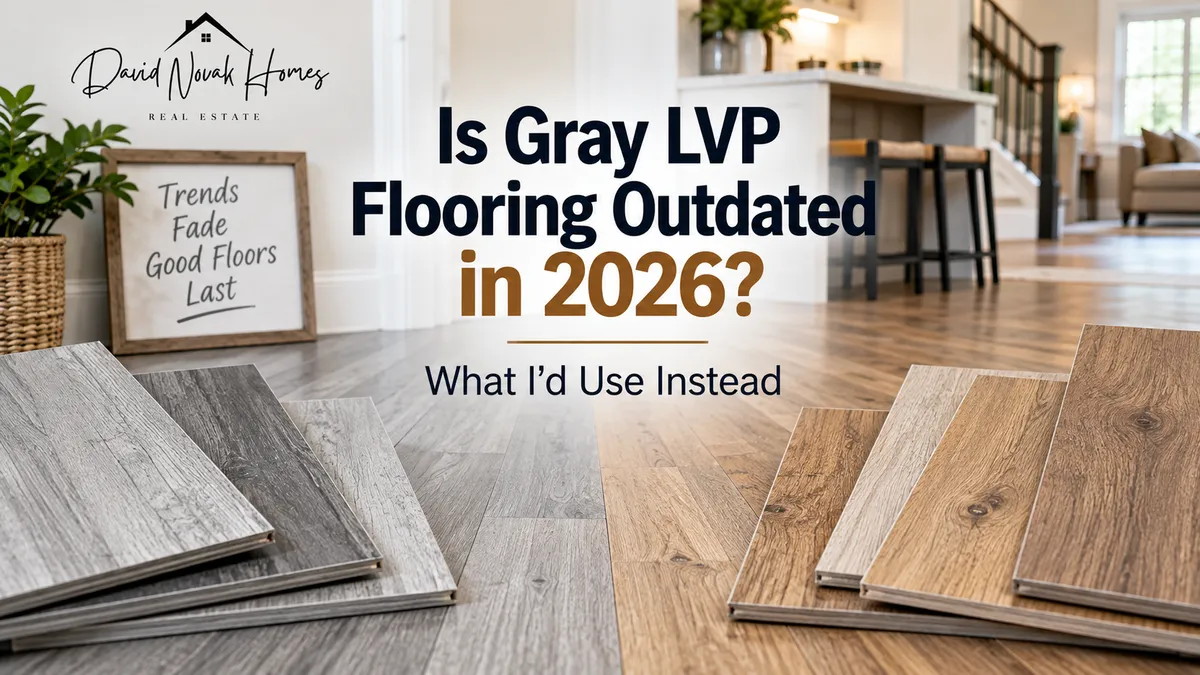
Is Gray LVP Flooring Outdated in 2026? What I’d Use Instead
If you are remodeling your home in 2026, I would think twice before installing cool gray luxury vinyl plank throughout the house.
LVP itself is not outdated. In fact, I still use it.
The problem is the color.
For years, gray flooring became almost the default choice for flips, rentals, and new renovations. Eventually so many homes used the same gray flooring, gray walls, white cabinets, and black fixtures that the look became instantly recognizable.
I don't think homeowners need to tear out good gray flooring just because design tastes are changing.
But if I'm choosing brand-new flooring today—especially for a home I may eventually sell—I generally prefer a warmer, more natural-looking wood tone.
For a broader comparison of LVP, hardwood, carpet, laminate, tile, and other flooring options, read my main guide: Best and Worst Flooring Choices for Your Home in 2026.
Is LVP Flooring Going Out of Style?
No.
This is an important distinction.
Gray LVP may be losing popularity. LVP itself isn't.
Luxury vinyl plank remains one of the more practical flooring products available for many homeowners because good-quality products can provide durability, relatively easy maintenance, water resistance, and a convincing wood appearance at a reasonable cost. It's also a flooring I've used in my own renovation and rental projects.
I especially like LVP when you're trying to balance:
Durability.
Appearance.
Budget.
Pets.
Kids.
Maintenance.
And resale.
That's a pretty difficult combination to beat.
The mistake is assuming that because one LVP color became overused, the entire flooring category is suddenly bad.
It isn't.
Why Gray Flooring Became So Popular
Gray flooring didn't become popular by accident.
For a while, it solved a problem.
Homeowners were moving away from darker brown flooring, yellow oak finishes, beige walls, and the Tuscan-inspired colors that dominated many homes in earlier decades.
Gray felt fresh.
It worked well with white cabinetry.
It worked with cool wall colors.
It paired easily with black and stainless-steel fixtures.
And for investors flipping homes, gray was easy.
You could essentially develop a formula:
Gray flooring.
Light gray walls.
White shaker cabinets.
White quartz.
Black hardware.
Repeat.
For a period of time, buyers loved it.
Then everyone did it.
That's usually how a trend begins to lose some of its appeal.
The "Flipper Gray" Problem
I flip homes myself, so I'm not saying this to attack flippers.
But we've all seen the look.
You walk into a remodeled house and immediately know approximately when it was renovated.
The flooring is a bluish-gray wood pattern.
The walls are another shade of gray.
The kitchen is bright white.
The hardware is black.
Everything is technically new, but somehow the house still feels dated.
That's the problem with choosing permanent finishes based entirely on what's fashionable at the moment.
Eventually the trend becomes a timestamp.
And flooring is a particularly expensive place to make that mistake because it covers so much of the house.
What Flooring Colors Are Replacing Gray?
I'm seeing the pendulum move back toward warmth.
That doesn't necessarily mean dark brown floors.
And it definitely doesn't mean we have to go back to orange oak.
Think more along the lines of:
Natural oak.
Light warm brown.
Honey without too much yellow.
Neutral beige-brown.
Soft walnut tones.
Natural wood colors with subtle variation.
These floors still work beautifully with white cabinets, but they also work with the warmer kitchens, wood accents, cream colors, muted greens, and more natural finishes that homeowners are gravitating toward.
That's one reason I think warmer flooring can have better staying power.
It doesn't lock the house into one specific decorating style.
What I Used in a Recent Older-Home Renovation
I've dealt with this exact decision in my own remodeling projects.
Instead of using the typical cool gray LVP that became common in flips, I chose a better-quality LVP with a softer, warmer wood appearance.
That wasn't because gray flooring suddenly became terrible.
I simply wanted the home to feel warmer.
The flooring still gave me the things I like about LVP—durability, ease of maintenance, and a product that can work across large portions of the house—but it didn't immediately scream "gray flip."
And that's really the balance I'm looking for.
I don't want buyers walking into a renovated older home and thinking:
"Somebody stripped all the personality out of this place."
I want it to feel updated while still feeling like a home.
Flooring Has a Bigger Effect Than Most People Realize
Homeowners often spend weeks choosing countertops and cabinet hardware.
Meanwhile, the floor may cover 1,500 square feet.
That makes it one of the largest visual surfaces in the entire home.
If that surface has a strong blue-gray undertone, it influences everything else you choose.
Suddenly your wall color needs to work with it.
Your cabinets need to work with it.
Your furniture needs to work with it.
Your backsplash needs to work with it.
That's why I prefer flooring that isn't overly committed to a specific color trend.
A natural wood appearance gives you much more flexibility.
Should You Replace Gray LVP Before Selling?
Usually, no.
This is where I don't want homeowners getting carried away.
If your gray LVP is:
In good condition.
Properly installed.
Clean.
Relatively neutral.
And consistent throughout the house.
I probably wouldn't recommend spending thousands of dollars replacing it solely because warmer flooring is becoming more popular.
You're selling a house, not entering a flooring fashion competition.
There is a big difference between:
"I wouldn't choose this flooring today."
and
"This flooring is going to prevent the house from selling."
Those are not the same thing.
If you're preparing a home for sale, I would look at the entire property before making that decision.
Maybe your money is better spent on paint.
Maybe the carpet needs replacement.
Maybe the kitchen lighting needs help.
Maybe the exterior desperately needs attention.
Replacing perfectly functional flooring might be nowhere near the top of the list.
When I Would Consider Replacing It
There are situations where I would be more aggressive.
For example, gray LVP may be worth replacing if it is extremely cheap-looking, heavily damaged, poorly installed, or fighting with every other finish in the home.
I'd also pay attention if the floor:
Moves or flexes underfoot.
Has separating planks.
Has major pattern repetition.
Has damaged edges.
Was installed poorly around transitions.
Looks blue against warmer cabinetry.
Changes flooring materials constantly from one room to another.
Buyers may not know the flooring manufacturer's name.
But they absolutely notice when the floor feels cheap under their feet.
Poor installation can also make buyers start wondering what else was done cheaply during the renovation. That's one of the issues I cover in my broader flooring guide.
Don't Buy LVP Based Only on Price Per Square Foot
This is probably one of the biggest mistakes I see.
Someone walks into a flooring store and asks:
"What's your cheapest LVP?"
That's not where I'd start.
Cheap doesn't automatically mean bad.
Expensive doesn't automatically mean good.
I'd look closely at the actual product.
How does the texture look?
How many different plank patterns are there?
How often does the printed grain repeat?
How wide are the planks?
How does it feel underfoot?
What does the wear layer look like?
How does the locking system feel?
How does the color look in natural light?
I've seen inexpensive floors that look surprisingly good.
I've also seen flooring that wasn't particularly cheap but still looked artificial once 1,000 square feet of it was installed.
The sample plank in your hand is not the same as seeing the entire main level covered in it.
Look at Large Samples Before You Decide
This is one thing I think homeowners should do more often.
Don't choose flooring based on a tiny sample under fluorescent showroom lights.
Take several boards home if possible.
Put them next to your kitchen cabinets.
Put them near your baseboards.
Look at them in daylight.
Look at them at night.
Lay several planks next to one another so you can see how the grain patterns repeat.
A floor can look completely different in your house than it did in the showroom.
And once you've installed 1,200 square feet, changing your mind becomes expensive.
Be Careful Mixing Warm and Cool Finishes
This is where gray LVP can create problems in older homes.
Let's say you have:
Warm oak cabinets.
Cream countertops.
Natural wood doors.
Warm brick fireplace.
Then you install a very cool blue-gray floor.
You can immediately create a disconnect between the original house and the new renovation.
Sometimes homeowners react by replacing everything else.
Now you've created a $50,000 renovation because of a flooring decision.
I'd rather pick a floor that works with the house from the beginning.
What About Real Hardwood?
If an older house already has good hardwood underneath carpet, I would absolutely investigate it before covering it.
Original hardwood can be one of the features buyers appreciate about an older home.
Sometimes refinishing those floors makes far more sense than installing LVP over them.
Hardwood also has the advantage of being something that can potentially be refinished multiple times depending on the floor, whereas manufactured flooring eventually reaches the end of its usable life.
That doesn't mean hardwood is automatically the right answer.
It costs more.
It can scratch.
Water can damage it.
Pets can be hard on it.
But don't destroy a good original feature without at least finding out what you already have.
What About Carpet?
I'm also not in the camp that believes carpet is dead.
I still think decent carpet with a good pad can work very well in bedrooms.
There's something comfortable about getting out of bed onto carpet instead of a cold hard surface.
For resale, one combination I often like is:
A durable hard surface throughout the main living areas.
Tile where it makes sense in bathrooms.
And a good mid-range carpet and pad in bedrooms.
You don't need the most expensive carpet available.
But I wouldn't install the absolute cheapest carpet with a paper-thin pad either.
Buyers can feel that immediately.
Flooring Mistakes I Would Avoid in 2026
The biggest mistake isn't choosing LVP.
It's choosing flooring without considering the house.
I would avoid installing the cheapest product available simply to say the flooring is new.
I would avoid extremely trendy colors if you're hoping the renovation will age well.
I would avoid five different flooring materials throughout one house.
I would avoid installing expensive flooring over a poorly prepared subfloor.
And I would be very careful installing a flooring product simply because every remodeled house you see online currently has it.
That's how we ended up with so much gray flooring in the first place.
What Flooring Makes Sense in Littleton and Southwest Denver?
Colorado homes have their own considerations.
We have snow.
We have mud.
We have pets tracking things inside.
We have basements.
And we have a huge variety of older ranches, split-levels, tri-levels, and two-story homes where the original architecture doesn't always work well with the newest design fad.
That's why I like durable flooring that still feels appropriate for the house.
In an older Littleton home, I may want to preserve original hardwood.
In another property, continuous warm-tone LVP may dramatically clean up a chopped-up main level.
In bedrooms, carpet may still be perfectly appropriate.
In bathrooms, I generally prefer tile or another moisture-friendly flooring.
There isn't one flooring product I'd install in every house.
The property should dictate the flooring—not the flooring store.
My Advice After Renovating Homes for Years
If I were choosing LVP today, I would lean toward a natural, warmer wood tone rather than a cold gray.
But I would put even more emphasis on quality and installation.
I'd rather have a good-quality, properly installed medium-priced LVP than an expensive product installed over a terrible subfloor.
And if you already have gray flooring that's in good condition?
Don't panic.
Your house isn't suddenly unsellable.
Look at the entire property.
Sometimes changing the wall color, lighting, furniture, and other finishes can soften the gray dramatically without replacing thousands of dollars worth of flooring.
The Bottom Line
Gray LVP isn't automatically bad, but I wouldn't make cool "flipper gray" my first choice for a new flooring installation in 2026.
LVP remains a practical flooring product.
The colors are simply evolving.
For many homes, I'd choose:
Warmer natural wood tones
Less obvious pattern repetition
A quality wear layer
A realistic texture
Proper subfloor preparation
Professional-looking installation
A color that complements the existing house
And before replacing flooring solely for resale, determine whether it's actually an improvement buyers are likely to reward.
For my complete breakdown of hardwood, LVP, tile, laminate, carpet, rentals, flips, and resale considerations, read Best and Worst Flooring Choices for Your Home in 2026.
Thinking About Replacing Flooring Before Selling Your Littleton Home?
Before spending several thousand dollars on flooring, it can be worth having someone look at the entire property.
Sometimes new floors make a tremendous difference.
Sometimes refinishing existing hardwood is the smarter move.
Sometimes replacing old carpet is all that's needed.
And sometimes I'd tell you to leave the flooring alone and spend the money somewhere else.
I'm David Novak, a Littleton Realtor with RE/MAX Professionals, and I've spent years working with buyers and sellers while also buying, renovating, flipping, and managing my own properties.
If you're thinking about selling an older or outdated home in Littleton or southwest Denver and aren't sure what is worth fixing first, I can help you prioritize it before you start spending money.
Call or text: 303-929-9660
Problem Home Solver

Are you tired of feeling like you can't trust real estate agents?
You’re not alone—and that’s exactly why I do things differently. With 30+ years in real estate, from running a mortgage bank to flipping homes and helping hundreds of families buy and sell, I’ve seen the good, the bad, and the downright ugly. My job isn’t to “sell” you—it’s to guide you with straight answers, real numbers, and options that actually make sense for your situation.
And if you’re not in my area, no problem—I can connect you with a top, experienced agent you can trust in your market.
👉 Fill out the form on my contact page or reach out directly, and let’s talk about how I can help you make the right move without the games.
Facebook
Instagram
X
LinkedIn
Youtube
Website