Check My Latest Blog Posts
Are White Kitchens Outdated in 2026? What Home Sellers Should Know
If you have a white kitchen and are thinking about selling your home, do not start ripping out perfectly good cabinets because someone online told you white kitchens are outdated.
White kitchens are not dead.
What is changing is the way homeowners and buyers respond to kitchens that feel overly cold, sterile, or dated by a very specific combination of white cabinets, white countertops, gray flooring, and black fixtures.
There is a big difference between a kitchen being less trendy and a kitchen actually hurting the sale of your home.
I cover that distinction along with several other changing kitchen styles in my main guide, Kitchen Trends That May Be Outdated in 2026, and Which Ones Still Work.
The bigger question for a homeowner isn't:
"Are white kitchens out?"
It's:
"Does my kitchen still look good to buyers?"
Those are two very different questions.
Why White Kitchens Became So Popular
There are some very practical reasons white kitchens have been popular for so long.
White cabinets can make a smaller kitchen feel brighter and more open.
They work with almost every countertop.
They are relatively easy to coordinate with flooring, backsplash, appliances, and paint colors.
And when I've renovated homes for resale, that flexibility has always mattered.
When you are renovating your own forever home, you can make extremely specific design choices.
When you are renovating something you're going to sell, you usually want enough personality to make the house attractive without creating a kitchen that only appeals to a small group of buyers.
White cabinetry has traditionally done that very well.
What Actually Makes Some White Kitchens Feel Outdated
Usually, it isn't the white cabinet itself.
It's everything surrounding it.
Think about the kitchen style that was everywhere for quite a while:
White shaker cabinets.
Bright white quartz.
White subway tile.
Cool gray LVP flooring.
Gray walls.
Black cabinet pulls.
Black faucet.
Black pendant lights.
Maybe a farmhouse sink thrown in for good measure.
None of those things individually are necessarily bad.
The problem is when every remodeled house starts looking exactly the same.
That's when buyers begin recognizing the era in which the renovation was done.
I've talked about this same issue with gray flooring.
There is nothing inherently wrong with LVP. I use LVP myself.
But certain gray flooring immediately tells you when many homes were remodeled.
Kitchens can work the same way.
Warmth Is Becoming More Important
If I were updating a white kitchen today, my goal wouldn't necessarily be replacing the white cabinets.
I'd look for ways to add warmth.
That could mean:
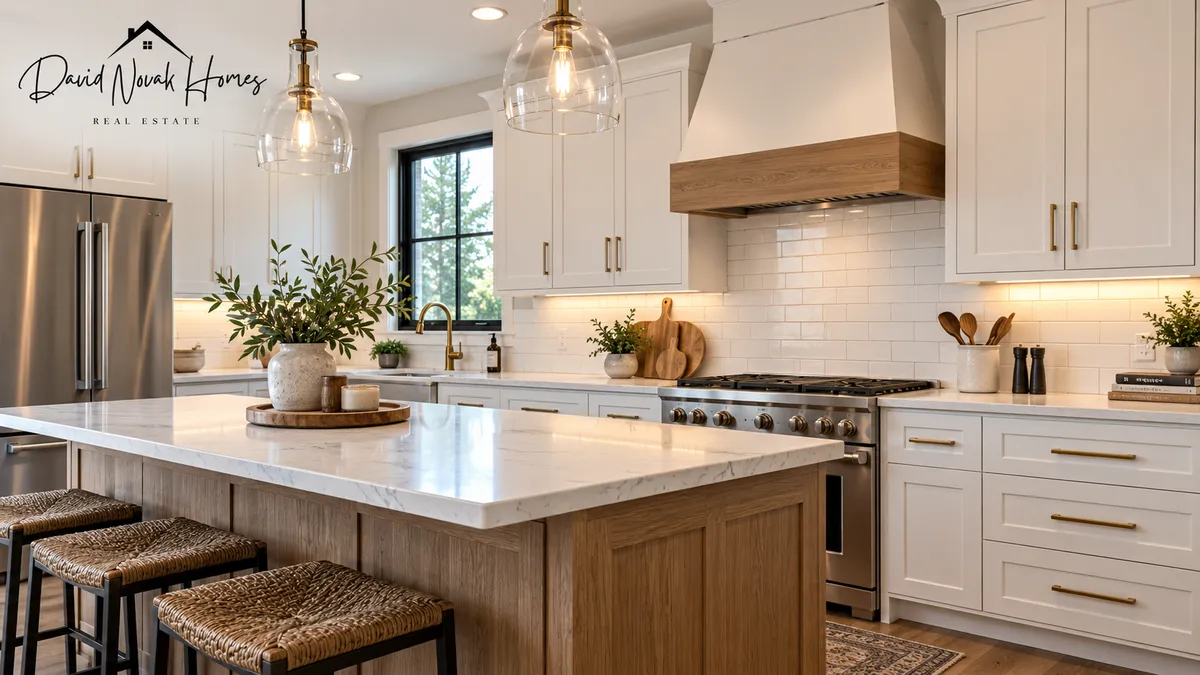
Natural wood accents
Warmer flooring
A wood or contrasting island
Warmer paint colors
More interesting backsplash tile
Brushed nickel or softer metal finishes
Warm pendant lighting
Countertops with more movement
Less stark black-and-white contrast
You can sometimes completely change the feel of a kitchen without replacing a single cabinet box.
That can make a lot more financial sense, especially if you're getting ready to sell.
Don't Confuse "Not Trending" With "Needs to Be Replaced"
This is one of my biggest problems with renovation trend lists.
A headline tells you:
"These 10 kitchen trends are officially OUT."
And suddenly homeowners think they need to spend $40,000 remodeling an otherwise perfectly functional kitchen.
That's not how I would look at it.
Buyers aren't walking through most homes carrying a checklist from a design magazine.
They're asking themselves:
Does this kitchen feel clean?
Does it feel updated?
Is there enough storage?
Are the countertops in good condition?
Do the appliances look decent?
Can I picture myself living here?
A kitchen doesn't have to be the newest style to answer those questions correctly.
For a broader look at features people are questioning right now—including open shelving, matte black hardware, subway tile, stainless appliances, and farmhouse design—read my 2026 kitchen trends guide.
Should You Paint Wood Cabinets White in 2026?
This is where things get interesting.
For years, painting dated wood cabinets white became almost automatic.
I wouldn't automatically do that today.
Some older wood cabinetry is coming back into favor simply because it brings natural warmth into the room.
That doesn't mean every 1980s oak kitchen suddenly looks fantastic.
There is still plenty of dated cabinetry out there.
But before covering quality wood cabinets with paint, I would look at the entire kitchen.
Sometimes changing the countertop, backsplash, hardware, wall color, and lighting can make the wood look intentional again.
Other times, the cabinets really do need updating.
The house itself matters.
When Painting Cabinets White Still Makes Sense
There are plenty of kitchens where white can still be a major improvement.
Imagine a smaller older Littleton ranch with a dark kitchen.
The cabinets are in good physical condition but have an unattractive finish.
There isn't much natural light.
The countertops and flooring are also dark.
Painting the cabinets a warm white or off-white could make the entire room feel larger and brighter without requiring a complete kitchen remodel.
That's very different from painting beautiful natural wood cabinets simply because white cabinets were fashionable.
I don't like remodeling based on a rule.
I like remodeling based on the individual house.
Warm White vs. Stark White
This is another small change that can make a surprisingly large difference.
Not every white is the same.
Some whites have very cool or blue undertones.
Others are softer and warmer.
If the goal is creating a kitchen that feels more comfortable and less clinical, a warmer white can work extremely well with:
Natural oak.
Warm-toned flooring.
Cream or beige countertops.
Soft greens.
Brass.
Brushed nickel.
Natural stone.
That combination can still give you the brightness of a white kitchen without making the room feel like everything came out of the same white-and-gray renovation package.
Are White Shaker Cabinets Outdated?
I wouldn't call them outdated.
I'd call them extremely common.
That's an important distinction.
Shaker cabinets are simple enough that they can work in traditional, transitional, farmhouse, and even fairly contemporary homes depending on the rest of the kitchen.
The bigger problem is expecting the cabinet door style itself to make the kitchen special.
If you're installing new cabinets today, there are certainly other choices worth considering.
But if you already have good-quality white shaker cabinets, I would rarely recommend tearing them out simply to chase a newer trend.
There are much less expensive ways to update the room.
What About White Kitchens in Older Homes?
This is an area where I think homeowners need to be especially careful.
I work with a lot of older homes around Littleton and southwest Denver.
One of the fastest ways to make an older home feel awkward is to force a completely different architectural personality into it.
A 1960s ranch doesn't have to look like a brand-new luxury home.
A 1970s house doesn't need every ounce of its original character removed.
A remodel should improve the house without necessarily erasing what made the house interesting in the first place.
Sometimes natural wood, warmer colors, and simpler finishes actually work better in these homes than an extremely stark white kitchen.
Should You Replace a White Kitchen Before Selling?
Usually, no.
If the cabinets are:
In good condition
Properly installed
Functioning well
Relatively neutral
Clean
Appropriate for the house
I would first look for cheaper improvements.
Maybe the hardware is dated.
Maybe the lighting is poor.
Maybe the backsplash is dragging the room down.
Maybe the walls are the wrong color.
Maybe the flooring is what actually makes the kitchen feel cold.
Maybe the countertops need attention.
Don't spend $30,000 fixing a $3,000 problem.
That's especially important when you're preparing a home for resale.
Updates That Can Warm Up a White Kitchen
Before replacing cabinetry, I would consider improvements such as:
Change the hardware.
Replacing overly trendy black hardware with brushed nickel, brass, or another finish can alter the entire look.
Update the lighting.
Old or overly industrial pendant lights can date a kitchen faster than the cabinets.
Add natural wood.
Wood stools, shelving, an island, or other details can break up the white.
Repaint the walls.
Moving away from cool gray can immediately make the kitchen feel warmer.
Change the backsplash.
A warmer, textured, or slightly more interesting tile can transform the room.
Look at the flooring.
Flooring covers a huge amount of visual space. Cold gray flooring can affect how the entire kitchen feels.
Declutter.
Sometimes the least expensive renovation is simply getting half the stuff off the countertops.
What I Would Avoid Before Selling
If you're planning to sell within the next year or two, I would be very careful about making an expensive change simply because you think buyers expect the newest kitchen trend.
Avoid:
Replacing good cabinets unnecessarily.
Installing an extremely unusual cabinet color.
Using expensive finishes that don't match the price point of the house.
Making every permanent surface trendy.
Following a design you saw online without considering the architecture of the home.
Assuming every buyer wants the same thing.
Kitchens are too expensive to renovate every time design tastes change.
That's one of the central points in my main article about which kitchen trends may be outdated in 2026 and which ones still work.
What Buyers Really Notice
After walking through a lot of homes with buyers, I've found that people don't necessarily describe kitchens using design terminology.
They don't always say:
"Those cabinets are no longer consistent with current design direction."
They say:
"This kitchen feels old."
Or:
"I like this kitchen."
Or:
"We wouldn't have to do much in here."
That's why presentation matters.
The combination matters more than any one finish.
A white kitchen can still feel fresh.
A brand-new kitchen can already feel dated if every decision was based on a short-lived trend.
My Advice From Renovating and Selling Homes
If you already have a white kitchen that is in good condition, I wouldn't panic.
Look at it objectively.
Does it feel cold?
Does it feel too gray?
Does it need some contrast?
Is the lighting bad?
Is the backsplash dated?
Are the cabinets actually the problem—or are you blaming them because you're hearing that white kitchens are going away?
Fix the real problem.
Not the headline.
Quick Takeaway
White kitchens are not obsolete in 2026.
What is changing is the preference for kitchens that feel warmer, more natural, and less cookie-cutter.
If you have good white cabinets, you can often update the kitchen with:
Warmer colors
Natural wood
New hardware
Better lighting
Updated backsplash
Warmer flooring
More texture and contrast
For homeowners preparing to sell, that can be a much smarter strategy than completely remodeling a functional kitchen.
Thinking About Updating Your Kitchen Before Selling in Littleton?
Before you start tearing out cabinets, I'd determine whether the kitchen actually needs a full renovation.
I've spent years buying, renovating, and selling homes, and one of the biggest mistakes I see homeowners make is spending money in places where the next buyer may never pay them back for it.
I'm David Novak, a Littleton Realtor with RE/MAX Professionals. I work with homeowners throughout Littleton and the surrounding southwest Denver area, particularly people dealing with older, outdated, or problem homes.
If you're thinking about selling and aren't sure whether your kitchen needs a complete remodel or a few strategic updates, I'm happy to take a look and give you my opinion before you start spending the money.
Call or text: 303-929-9660

Are you tired of feeling like you can't trust real estate agents?
You’re not alone—and that’s exactly why I do things differently. With 30+ years in real estate, from running a mortgage bank to flipping homes and helping hundreds of families buy and sell, I’ve seen the good, the bad, and the downright ugly. My job isn’t to “sell” you—it’s to guide you with straight answers, real numbers, and options that actually make sense for your situation.
And if you’re not in my area, no problem—I can connect you with a top, experienced agent you can trust in your market.
👉 Fill out the form on my contact page or reach out directly, and let’s talk about how I can help you make the right move without the games.
Facebook
Instagram
X
LinkedIn
Youtube
Website