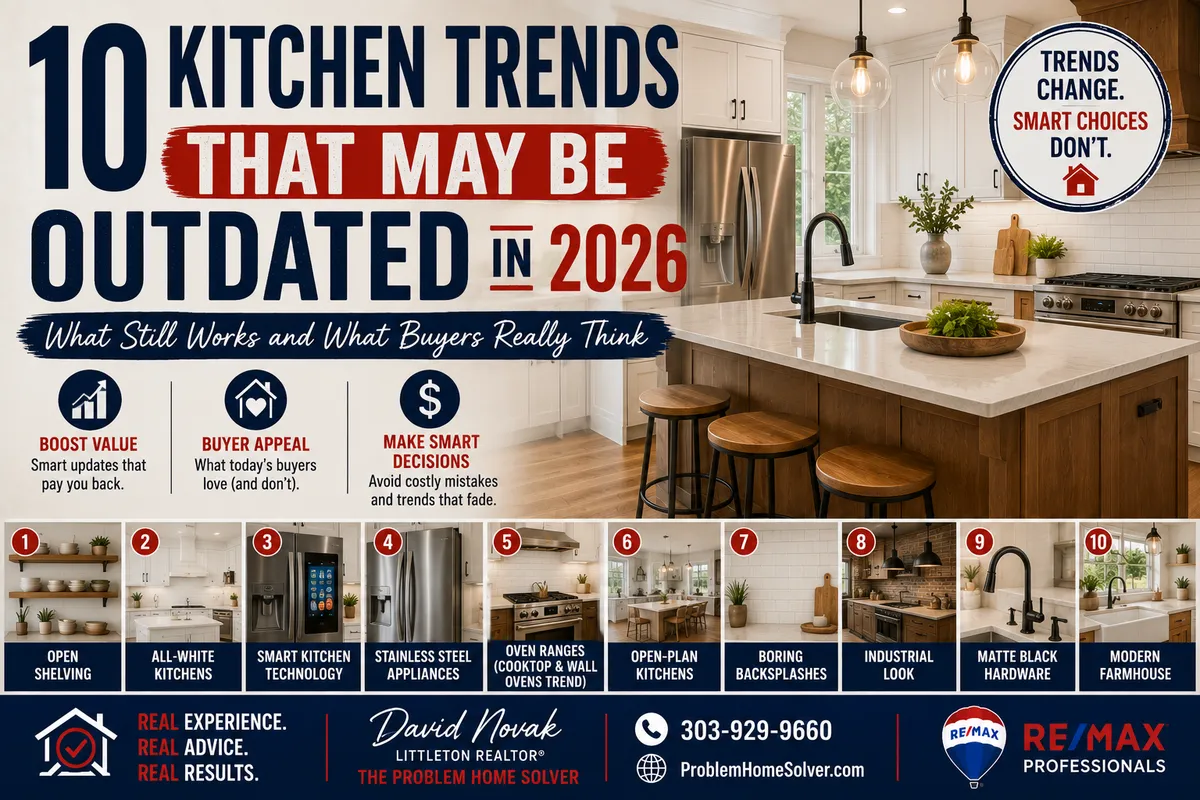
Kitchen Trends That May Be Outdated in 2026, and Which Ones Still Work
Updated August 2026
Every year another list comes out telling homeowners their kitchen is outdated.
White cabinets are supposedly finished.
Stainless appliances are going away.
Open-concept kitchens are dead.
Subway tile is over.
Matte black hardware has had its day.
I would be careful taking any of those statements too literally.
I have spent years flipping and renovating houses and walking through homes with buyers. What I've learned is that there is a big difference between a design feature becoming less trendy and buyers suddenly no longer wanting it.
Current 2026 kitchen research does show a noticeable move toward warmer, more natural interiors. The National Kitchen & Bath Association reports growing interest in wood-grain cabinetry, with white oak particularly popular, along with organic colors and natural materials.
But that does not mean every white kitchen, stainless appliance, subway tile backsplash, or open floor plan suddenly needs to be ripped out.
Here is how I would look at some of the kitchen trends people are calling outdated in 2026.
1. Open Shelving
Open shelving is one trend where I understand the pushback.
It looks great in photographs.
In everyday life, it can be another story.
People want storage. They want somewhere to put mismatched glasses, food containers, coffee cups, and all the other things that don't belong in a carefully staged photograph.
Open shelves also collect dust and cooking residue.
That is why concealed storage continues to be so important in kitchen design. Even forward-looking design forecasts are emphasizing better concealed storage and highly functional kitchen zones rather than sacrificing practicality for appearance.
I've never relied heavily on open shelving in my renovation projects because cabinetry is usually the safer choice.
If you already have open shelves and don't want to remodel, you don't necessarily need to remove them.
Attractive baskets, containers, and intentionally grouped items can reduce visual clutter.
You can also combine a limited amount of open shelving with traditional cabinets.
A little open shelving can add character.
An entire kitchen without enough enclosed storage can become frustrating.
2. The All-White Kitchen
This may be the most frequently declared "dead" kitchen trend.
I don't buy it.
The all-white-everything kitchen is definitely losing some of its dominance. Current 2026 design trends are moving toward warmer woods, earthy greens, browns, off-whites, and layered natural finishes.
That is different from saying white kitchens are bad.
White cabinets can still make a small kitchen feel larger and brighter.
They still coordinate with almost anything.
And when I'm renovating for resale, white cabinetry remains something I will consider because it gives me flexibility.
The bigger change is how white is being used.
Instead of white cabinets, white countertops, white backsplash, white walls, and cold gray flooring, I would add warmth.
Think:
Natural wood.
Warmer countertops.
A contrasting island.
Brushed nickel or warmer metal finishes.
Subtle color.
Textured backsplash.
You don't necessarily need to rip out a perfectly good white kitchen because someone declared it outdated.
3. Smart Kitchen Technology
I'm mixed on this one.
Smart appliances can offer legitimate benefits.
But technology for the sake of technology doesn't automatically make a kitchen better.
A refrigerator with a large screen might appeal to one homeowner while another buyer sees something expensive that could eventually break.
That is the question I would ask:
Does the technology make everyday life easier?
If it does, great.
If it is there mostly because it looks impressive in a showroom, I would think twice about paying a major premium for it.
Technology certainly isn't disappearing. Homes are continuing to incorporate more connected, efficient, and energy-conscious features. Zillow's 2026 housing trend analysis, for example, found growing interest in sustainable and green home features.
I just wouldn't assume every smart feature automatically improves resale value.
4. Stainless Steel Appliances
I have a hard time believing stainless steel appliances are suddenly finished.
I still see them constantly.
I still use them on renovations.
And they remain easy to coordinate with most kitchens.
There is more competition now.
Black stainless, matte finishes, colored appliances, and panel-ready appliances are giving homeowners alternatives. Panel-ready appliances in particular are part of the move toward more integrated kitchens.
But that doesn't make traditional stainless a mistake.
For a resale renovation, I would still feel perfectly comfortable installing stainless appliances if they fit the property.
This is another example of something becoming less exclusive rather than obsolete.
5. The Traditional Range
Another claim I hear is that freestanding ranges are being replaced by separate cooktops and wall ovens.
In some kitchens, absolutely.
Luxury homes often have the room and budget for separate cooking appliances.
They can also provide excellent functionality.
But there are millions of kitchens where a traditional range makes much more sense.
It is compact.
It performs two jobs.
It doesn't require redesigning the entire cabinet layout.
On many of my flips, I'm sticking with a range.
I don't see that changing simply because a more expensive configuration exists.
Match the appliances to the house.
A luxury kitchen and a modest 1960s ranch don't necessarily need the same solution.
6. Open-Concept Kitchens
The completely open floor plan has definitely faced more criticism.
And I understand why.
Noise travels.
Kitchen mess is visible.
Working from home changed how many people think about separation.
Families sometimes want quiet rooms again.
But I don't believe the open kitchen is disappearing.
What I think is happening is that homeowners are becoming more selective about how open they want the house to be.
When I'm renovating, I don't automatically remove every wall.
I look at the flow.
Sometimes opening a wall transforms the property.
Other times the wall creates useful separation.
This is one of those decisions where the architecture of the individual home matters more than whatever happens to be trending this year.
7. Subway Tile Backsplashes
Subway tile has supposedly been going out of style for years.
And somehow it keeps showing up in kitchens.
Why?
Because it is simple, relatively affordable, easy to work with, and adaptable.
What is changing is the competition.
Current kitchen design is increasingly using slab backsplashes and countertop materials continued vertically up the wall for a seamless appearance.
Those can look fantastic.
They can also cost substantially more.
For the average renovation or flip, I still believe a well-selected tile backsplash can be a perfectly good solution.
You can update the look through tile size, layout, grout, texture, or color without abandoning the basic concept.
Not every house needs a massive slab of stone running up the wall.
8. Industrial Kitchens
Industrial kitchens typically use things like:
Exposed brick.
Metal.
Stainless steel.
Dark finishes.
Open shelving.
Reclaimed wood.
Those materials can create a very distinctive look.
The problem is that current kitchen design is moving strongly toward warmth and comfort. Natural materials, wood grains, earthy colors, and softer finishes are increasingly prominent in 2026.
A heavily industrial kitchen can feel cold by comparison.
Does that mean industrial design is gone?
No.
In a loft, converted warehouse, or home with the right architecture, it can still look fantastic.
I just wouldn't force that style into a house where it doesn't belong.
9. Matte Black Hardware
I have used a lot of matte black hardware.
Builders have used a lot of matte black.
Flippers have used a lot of matte black.
Homeowners have used a lot of matte black.
That is probably part of the problem.
It isn't necessarily unattractive.
It just isn't as unique anymore.
Warmer metals and mixed finishes are giving homeowners other options, with 2026 trends emphasizing finishes that feel warmer and more layered.
Brushed nickel is another finish I have used extensively and still believe can work extremely well.
I wouldn't remove good matte black hardware just because the trend has cooled.
But if I'm choosing finishes today, I would look at the entire kitchen instead of automatically making every fixture black.
10. Modern Farmhouse Kitchens
Modern farmhouse is another design style suffering from overexposure.
White shaker cabinets.
Black hardware.
Farmhouse sink.
Barn doors.
Rustic wood.
Pendant lights.
We have seen the combination everywhere.
That doesn't mean a farmhouse kitchen suddenly looks bad.
The biggest factor is the house itself.
If you're living in a country-style property, farmhouse elements may fit perfectly.
In a suburban or urban home, you may want to soften some of the more obvious farmhouse details.
You don't necessarily need a complete remodel.
Changing hardware, stools, lighting, wall color, accessories, or a backsplash can shift the appearance substantially.
I have a soft spot for the farmhouse look because of my own farming background, but I also recognize that homeowners increasingly want kitchens that feel more personalized rather than copied directly from a design template.
That broader move toward personalization is showing up in current housing design trends as well.
What Is Actually Trending in Kitchens in 2026?
The biggest change I see isn't one specific cabinet color or countertop.
It is a move toward warmer, more functional, more individual kitchens.
The 2026 NKBA kitchen research points toward natural wood cabinetry, especially white oak, organic neutral colors, quartz and quartzite, and increased use of natural materials.
Other current design reporting is showing similar themes: wood grain, earth tones, softer colors, integrated appliances, thoughtful storage, and kitchens that feel comfortable rather than sterile.
That is important because homeowners sometimes interpret trends too literally.
You don't need to change everything.
Sometimes adding natural wood to a white kitchen is enough.
Sometimes replacing hardware changes the whole room.
Sometimes adding a warmer backsplash, paint color, or lighting is all the kitchen needs.
What I See With Buyers in Littleton and the Denver Metro Area
This is where my perspective differs from someone simply looking at design magazines.
I'm walking through actual houses with buyers.
And buyers don't all want the same thing.
I've had buyers love open concepts and others wish there were more walls.
Some love white kitchens.
Others immediately talk about replacing them.
Some want the newest technology.
Others want appliances that are simple and reliable.
That is why I am very cautious when someone says a particular style is officially "out."
Real estate doesn't work that cleanly.
The architecture, price range, neighborhood, condition, and buyer all matter.
Mistakes to Avoid When Following Kitchen Trends
The biggest mistake is renovating based entirely on what is popular at this exact moment.
Kitchens are expensive.
Trends change faster than cabinets.
If you're spending tens of thousands of dollars, try to keep the expensive permanent components relatively adaptable.
Cabinets.
Countertops.
Flooring.
Layout.
Those should ideally have some longevity.
Then use things that are easier to replace for more personality.
Hardware.
Paint.
Stools.
Decor.
Lighting.
Accessories.
That gives you flexibility without remodeling every five years.
My Advice From Flipping and Selling Homes
I've renovated enough kitchens to know that you can chase trends forever.
The safer approach is to ask three questions:
Does it fit the house?
Does it function well?
Does it appeal to enough potential buyers if resale matters?
That is why I continue using some features that regularly appear on "outdated" lists.
White cabinets can still work.
Stainless steel appliances can still work.
Ranges can still work.
Subway tile can still work.
Open layouts can still work.
It all comes down to execution.
Quick Takeaway
For 2026, I would look at these trends this way:
Open shelving: Use selectively. Storage still matters.
White kitchens: Not dead, but warmer combinations are gaining ground.
Smart appliances: Useful when the technology actually serves a purpose.
Stainless appliances: Still practical, although there are more alternatives.
Ranges: Still perfectly appropriate in most kitchens.
Open concepts: Becoming more balanced rather than disappearing.
Subway tile: No longer unique, but still useful and adaptable.
Industrial kitchens: Better when the architecture supports the style.
Matte black hardware: Still usable, but no longer the only fashionable choice.
Modern farmhouse: Overexposed, but far from unusable.
The best kitchen isn't necessarily the most fashionable kitchen.
It's one that functions well, fits the home, fits your lifestyle, and won't make you feel like you need to renovate it again the moment another trend report comes out.
Thinking About Updating a Kitchen Before Selling in Littleton?
If you're thinking about remodeling before putting your house on the market, don't assume you have to eliminate every supposedly outdated feature.
Sometimes a full renovation is appropriate.
Other times, paint, hardware, lighting, countertops, backsplash, flooring, or a few targeted changes can significantly improve how the kitchen presents.
I'm David Novak, a Littleton Realtor with RE/MAX Professionals, known as the Problem Home Solver. I work with homeowners, buyers, and investors throughout Littleton and the surrounding Denver metro area, including older and outdated homes.
If you're trying to decide what is worth changing before you sell, I'm happy to help you evaluate the property.
Call or text: 303-929-9660
Visit: ProblemHomeSolver.com


